

Why your boss’s raise request might be more dangerous than it sounds
In the early 1970s, something strange started happening in America. Workers asked for raises not because their bosses were suddenly generous, but because everyone just knew prices were going up next year anyway. So businesses gave the raises. Then they raised prices to cover the cost. Then workers, seeing prices go up again, asked for bigger raises next time.
Nobody was being greedy, exactly. Everyone was just reacting to what they expected was coming.
That’s the trap. And it’s worth understanding right now, because some of the same warning signs are flashing again.
The man who didn’t see it coming
Arthur Burns became chairman of the Federal Reserve in 1970. Inflation was already running around 6%, and Burns had a choice: tighten money and risk a recession, or keep things loose and hope the problem sorted itself out.
He chose loose. Rates came down even as inflation stayed hot.
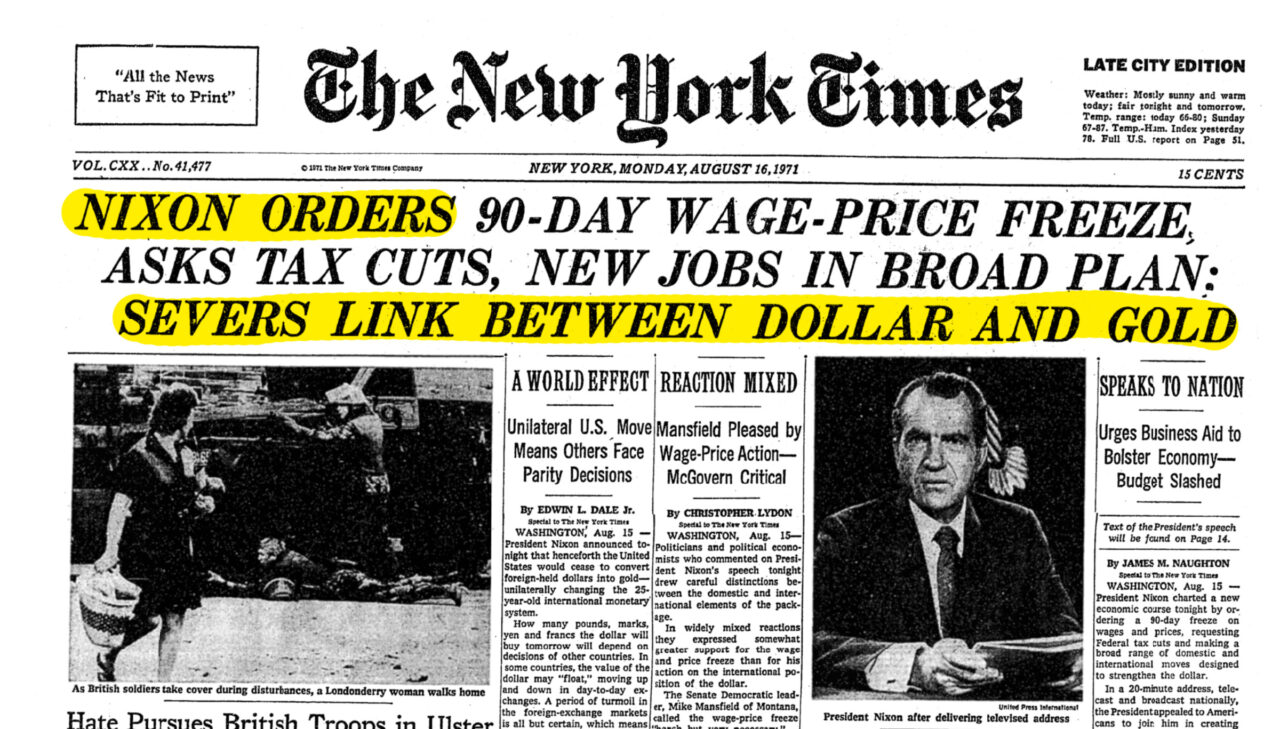
Then in August 1971, Burns and President Nixon went a step further. They froze wages and prices outright, and took the U.S. dollar off the gold standard. For a moment it looked like it worked. Inflation dipped.
But underneath, something had shifted. When people expect inflation, they demand higher wages, which forces higher prices, which confirms the original expectation. Burns had effectively trained the country to expect inflation, and that expectation became self-fulfilling.
Then came 1973, and OPEC.
Oil, war, and a feedback loop
After the Yom Kippur War, the OPEC nations cut off oil exports to the U.S. and other countries that supported Israel. Oil prices quadrupled almost overnight.
That’s a real shock. Real costs went up. Gas lines formed. Heating bills jumped.
But here’s the part that mattered most for the next decade: people didn’t treat it as a one-time spike. They treated it as confirmation. See, I told you prices would keep rising. Wage contracts (many of them union contracts with built-in cost-of-living adjustments) baked in the assumption that this was the new normal.
By 1979, inflation hit nearly 13%. By 1980, it touched 14.8%.
Volcker’s brutal fix
Paul Volcker took over the Fed in August 1979. His diagnosis was blunt: the problem wasn’t oil prices anymore. The problem was that everyone, workers, businesses, investors, had stopped believing inflation would ever come down. And as long as they believed that, it wouldn’t.
So Volcker did something almost nobody wanted. He jacked the federal funds rate up to a record high of 20% in late 1980. Mortgage rates went above 18%. Unemployment rose under his term to over 10% by late 1982, the highest since the Great Depression.
It was, by any measure, painful. Steel towns and farm communities took the hardest hit.
But it worked. Inflation fell from 14.8% in March 1980 to 6.2% by the end of 1982, and down to 3.2% by 1983. More importantly, something less visible happened too. Inflation expectations, the forward-looking beliefs that drive wage demands and price-setting, broke sharply.
Once people believed the Fed would actually do whatever it took to keep prices stable, they stopped acting like inflation was inevitable. That belief became the foundation for roughly 40 years of low, stable inflation.
Why this matters again now
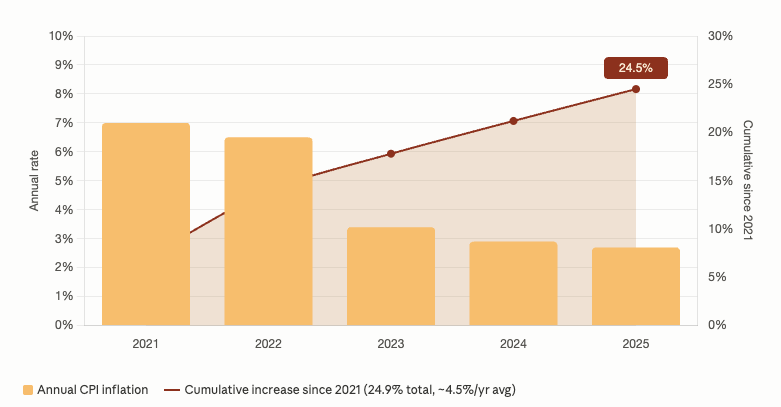
Here’s the uncomfortable part. We’ve spent the last 5 years averaging inflation north of 4%, well above the Fed’s 2% target. And the data on what people expect next is starting to drift.
As of May 2026, consumers’ 5-year inflation expectations climbed to 3.9%, up from 3.4% the month before. Year-ahead expectations have edged up to 4.8%. That’s well above the 2.3% to 3.0% range that was normal in the two years before the pandemic.
Some of this is tied to specific events (the report points to supply disruptions in the Strait of Hormuz pushing gas prices higher), the same way the 1970s shock started with oil. The question is whether it stays a one-time event in people’s minds, or whether it starts to feel like the new normal.
The real estate tug-of-war
If you own real estate, inflation isn’t simply good or bad for you. It pulls in two directions at once.
On one side, inflation tends to lift the things that matter most for property values. Rents rise. Replacement costs (the cost to build a new version of your building) rise too. Over time, that pushes the value of the asset itself higher. This is a big part of why real estate has historically been seen as an inflation hedge.
On the other side, there’s the interest rate effect, and this one runs in the opposite direction.
Long-term interest rates, like the 10-year and 30-year Treasury yields, aren’t just “the cost of money.” They include compensation for what lenders expect inflation to do over the life of the loan. If a lender expects inflation to average 4% over the next decade, they won’t lend at 4%. They’d be losing money in real terms. So they demand a higher rate, one that covers expected inflation plus an actual return on top.
So when inflation expectations rise, long-term rates tend to rise with them, even before the Fed moves short-term rates at all. We’ve already seen this dynamic before, when the cost of borrowing climbed sharply as inflation took hold in the 1970s, discouraging new investment. And we’re seeing the early signs of it again now, with longer-term rates responding to the recent jump in inflation expectations.
Higher rates hit real estate valuations directly. Cap rates and interest rates aren’t locked together one-to-one, but they’re closely related. When borrowing costs go up, buyers can’t pay as much for the same building, because more of the rent now has to cover a bigger interest payment. That tends to push cap rates up and valuations down.
So you’ve got two forces pulling at the same time. Rising rents and replacement costs pushing values up. Rising rates pushing values down. Which one wins depends on the property, the market, and how fast each force is moving. A building with strong rent growth in a market with limited new supply might ride out higher rates just fine. A building that’s more rate-sensitive, maybe one with thinner margins or more debt, might feel the rate side of this much more sharply.
This is exactly why “inflation is good for real estate” is too simple a story. It’s good for the parts of the equation tied to income and replacement cost. It’s a headwind for the parts tied to financing. Right now, both forces are active.
Why this is really about psychology
Most people think economics is about spreadsheets, interest rates, money supply. And those things matter. But underneath all of it is a simpler question: what do people believe is going to happen?
If a business owner believes their costs will be 5% higher next year, they raise prices now to get ahead of it. If a worker believes their paycheck will buy less next year, they ask for a raise now. If an investor believes the dollar will be worth less, they demand a higher return to lend money at all.
None of those decisions require inflation to actually be coming. They just require people to believe it’s coming. And once enough people believe it and act on that belief, they make it true.
That’s what Burns missed and what Volcker understood. You can’t just manage the numbers. You have to manage what people expect the numbers to do next, because expectations are not just a forecast. They’re an input.
The takeaway
Right now we’re not in 1979. Unemployment isn’t double digits, rates aren’t at 20%, and the Fed has 50 years of credibility that Burns didn’t have to fall back on.
But expectations have been drifting up for a while now, and the longer they sit elevated, the more they risk becoming a fact on the ground rather than just a prediction. The 1970s didn’t get fixed by waiting it out. It got fixed when the Fed proved, through real pain, that it would not tolerate high inflation as a permanent condition.
For real estate specifically, that means watching both sides of the ledger. Don’t just track whether rents are keeping pace with inflation. Track what’s happening to long-term rates too, because that’s the side of the equation that can move faster and catch people off guard.
