


Every investor wants to know what happens next. Will mortgage rates fall? Is a recession coming? Are home prices going up or down? Which markets will outperform? These questions dominate headlines, podcasts, and social media because predicting the future feels like an advantage. But after decades of investing, many of the most successful real estate investors come to the same conclusion: predictions are overrated.
The investors who consistently build wealth aren’t necessarily the ones who forecast the future accurately. They’re the ones who develop a repeatable process that works across different market conditions. In real estate, where cycles are inevitable and uncertainty is constant, process often matters far more than prediction.
The Future Is Inherently Unpredictable
If the last decade has taught investors anything, it’s that markets rarely behave exactly as expected.
Few people predicted the speed of the post-pandemic housing boom. Even fewer anticipated inflation rising to multi-decade highs, interest rates climbing as rapidly as they did, or the dramatic shift in remote work and migration patterns. Investors who built strategies around specific forecasts often found themselves adjusting course repeatedly.
This isn’t because economists, analysts, or investors are unintelligent. It’s because the economy is influenced by countless variables -monetary policy, geopolitical events, consumer behavior, demographic trends, technological change, and human psychology. Even small changes in one area can create major shifts elsewhere.
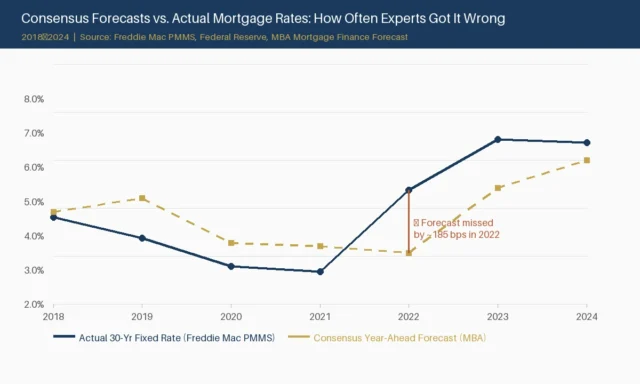
Year-ahead mortgage rate forecasts from major financial institutions frequently missed actual outcomes by wide margins – including by nearly 185 basis points in 2022. Source: Freddie Mac PMMS; MBA Mortgage Finance Forecast.
The reality is that predicting the future consistently is extraordinarily difficult.
The best investors understand this. Instead of trying to forecast every market movement, they focus on building systems that can perform under a wide range of scenarios.
A Strong Process Creates Consistency
Process isn’t exciting. It doesn’t make headlines or generate viral predictions. But it creates something far more valuable: consistency.
A disciplined investment process typically includes clear criteria for market selection, conservative underwriting assumptions, risk management guidelines, and long-term capital allocation strategies. These systems create structure and remove emotion from decision-making.
When investors have a repeatable framework, they don’t need to reinvent their strategy every time the market changes. They evaluate opportunities using the same principles regardless of whether interest rates are rising or falling.
This consistency becomes a major competitive advantage.
Many investors make good decisions during strong markets. The investors who last decades are the ones who continue making rational decisions during difficult markets.
Predictions Often Lead to Emotional Investing
One of the biggest problems with prediction-based investing is that it encourages emotional decision-making.
When investors become convinced that rates are about to fall, they may overpay for assets expecting future appreciation. When they believe a recession is imminent, they may hold excessive cash and miss opportunities. Optimistic forecasts encourage risk-taking, while pessimistic forecasts often create paralysis.
In both cases, the investment decision becomes tied to a specific outcome.
The problem is that when reality doesn’t match expectations, emotions take over.
A process-oriented investor behaves differently. Instead of asking, “What do I think will happen?” they ask, “Will this investment still work if I’m wrong?”
That subtle shift changes everything.
Risk Management Is More Important Than Being Right
Many people assume the best investors are right most of the time. In reality, successful investors are often wrong—just not catastrophically wrong.
This distinction matters.
Process-driven investors build margin for error into their decisions. They maintain reserves, avoid excessive leverage, and stress-test assumptions. They assume unexpected events will happen because they always do.
As a result, they don’t need perfect predictions to succeed.
Markets can slow down. Interest rates can rise unexpectedly. Operating expenses can increase. If the investment was structured conservatively from the beginning, these challenges become manageable rather than catastrophic.
Risk management isn’t about eliminating uncertainty. It’s about creating resilience.
And resilience comes from process, not prediction.
Great Investors Focus on What They Can Control
There are countless variables investors cannot control.
They cannot control Federal Reserve policy. They cannot control inflation, election outcomes, oil prices, or global conflicts. They cannot control consumer sentiment or mortgage rate movements.
But there are many things they can control.
They can control how much leverage they use. They can control their underwriting assumptions. They can control the markets they choose to invest in, the quality of their due diligence, and the amount of liquidity they maintain.
The best investors direct most of their energy toward these controllable variables.
This mindset is powerful because it shifts attention away from external uncertainty and toward internal discipline.
Over time, small improvements in process compound into meaningful advantages.
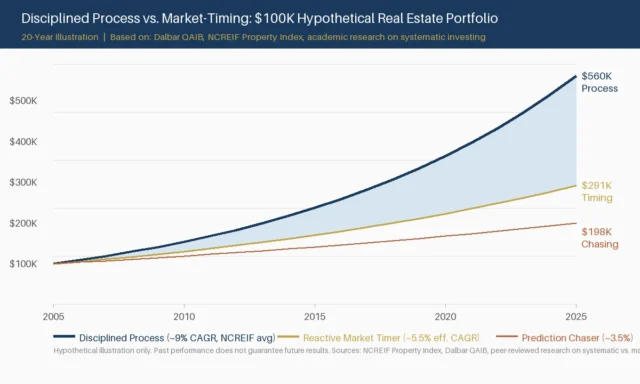
A disciplined, process-driven approach compounded significantly ahead of reactive timing strategies over a 20-year period. Hypothetical illustration based on NCREIF long-run averages and Dalbar behavioral research. Past performance does not guarantee future results.
Long-Term Wealth Is Built Through Repetition
Real estate wealth is rarely created through a single great prediction.
More often, it’s built through years of making solid decisions repeatedly.
Buying quality assets. Managing them well. Maintaining reserves. Reinvesting cash flow. Staying disciplined during downturns. Avoiding unnecessary risk.
These actions may not seem extraordinary individually. But over long periods, they create extraordinary outcomes.
The compounding effect of good decisions is one of the most underappreciated forces in investing.
This is why many of the wealthiest real estate investors are not known for predicting market tops or bottoms. They’re known for their discipline and consistency.
Their edge isn’t foresight.
It’s process.
Markets Change, Principles Endure
Every real estate cycle feels unique while it’s happening.
At one point, investors worried about the housing crash. Then they worried about inflation. Then rising rates. Today, many are debating when rates will fall and how quickly demand will recover.
The specific concerns change, but the underlying principles remain remarkably consistent.
Buy quality assets. Manage risk carefully. Maintain flexibility. Focus on cash flow. Think long term.
These principles have survived recessions, booms, inflationary periods, and changing political environments.
That’s the power of process. It doesn’t require perfect forecasts because it’s designed to adapt.
The Real Competitive Advantage
Investors spend enormous amounts of time trying to predict what markets will do next.
But the investors who consistently outperform often ask a different question: What process will help me make good decisions regardless of what happens next?
That question doesn’t eliminate uncertainty.
It eliminates dependence on certainty.
The best investors understand that predictions are temporary, but processes endure. Markets will always change. Economic cycles will continue. Interest rates will rise and fall. Trying to forecast every turn is exhausting—and often ineffective. A disciplined investment process, on the other hand, creates consistency through uncertainty. It allows investors to make rational decisions, manage risk intelligently, and stay focused on long-term wealth creation. Because in the end, success in real estate isn’t determined by how accurately you predict the future. It’s determined by how well you prepare for whatever future arrives.
